
Wet Basement in Omaha Home? 2026 Repair Costs & Negotiation Tips
⏱️ The 30-Second Takeaway
- Is it a dealbreaker? Rarely. 95% of Omaha moisture issues are fixable maintenance items, not structural failures.
- The Cost: Standard waterproofing runs $2,500–$10,000. Major structural repairs can hit $25k+.
- The Strategy: Negotiate a 5–15% price reduction. It’s better to control the repair quality yourself after closing.
Finding a wet basement during your Omaha home search can feel alarming, but it rarely needs to be a dealbreaker. With 60% of U.S. basements experiencing water intrusion—and Omaha's clay-rich soils making moisture issues nearly universal the real question is whether the cause is manageable or structural. This guide walks you through exactly what to look for, what it costs to fix, and when to negotiate versus walk away.
Why Wet Basements Are Common in Omaha
Omaha's geology makes basement moisture an operational expectation rather than a defect. The region sits on high-concentration montmorillonite clay soils that expand when wet and contract when dry—a cycle that repeats throughout each season and places constant stress on foundations. Combined with annual freeze-thaw cycles, humid summers influenced by the Missouri River valley, and spring thaw conditions that force snowmelt laterally against foundations, basement moisture is simply part of homeownership in this market.
The statistics reinforce this reality: 98% of basements nationwide experience some water damage during their lifetime, and 30% of new Midwest homes experience water intrusion within the first year. For move-up buyers, this means a wet basement should be evaluated as a cost line item rather than an automatic disqualifier. The critical distinction is whether you're looking at manageable moisture—fixable for $2,500 to $5,000—or structural failure requiring $25,000 or more in repairs.
Minor Fixes vs. Major Problems
Most basement moisture issues fall into the fixable category and can be resolved with standard waterproofing systems. Structural problems are less common but require immediate identification because repair costs escalate quickly.
Cosmetic and Readily Fixable Issues
Efflorescence appears as white, powdery crystalline deposits on basement walls. This indicates active moisture—salts left behind as seeping water evaporates—but poses no structural or health risk. The deposit disappears once you address the underlying moisture source, typically with an interior waterproofing system costing $2,500 to $5,000.
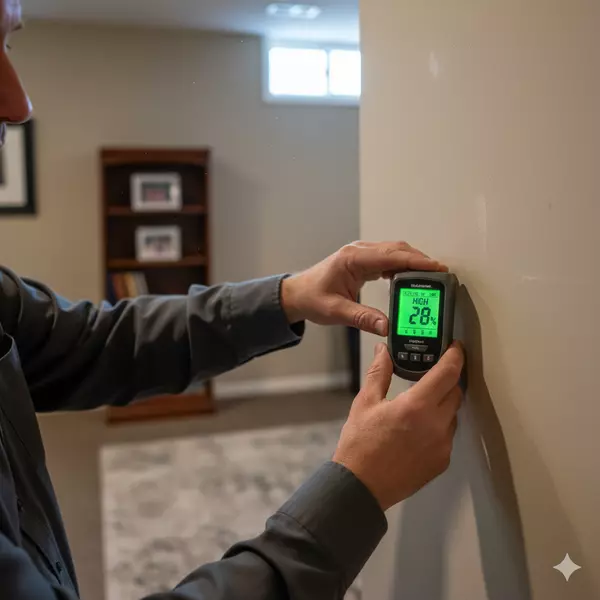
Damp walls without visible cracks suggest inadequate drainage rather than foundation failure. A musty odor and visible moisture or staining point to high humidity, capillary moisture rise through concrete, or seasonal seepage. An interior perimeter drain, sump pump, and dehumidifier resolve most cases for $2,500 to $5,000.
Seepage at the cove joint—where the basement floor meets the wall—is extremely common in clay-soil areas. Hydrostatic pressure from saturated soil pushes water through this joint, but it does not indicate foundation failure. Interior perimeter drain systems handle this effectively for $2,000 to $4,000.
Fresh basement paint warrants investigation. Recent paint can signal a cover-up of prior water damage. Ask the seller for documented water damage history and inspect behind painted areas for staining patterns.
Structural Red Flags
Horizontal foundation cracks running straight and level across basement walls indicate severe hydrostatic pressure pushing the wall inward. This represents active structural pressure and potential wall failure. A structural engineer evaluation is mandatory, and repair costs typically range from $10,000 to $25,000 or more. If recommendations exceed 10 to 15% of the purchase price, walking away is the prudent choice.
Bowing or bulging walls show visible inward curves. Minor bowing under two inches can often be stabilized with carbon fiber straps at $3,625 to $4,800 for a typical wall. Severe bowing exceeding three inches requires excavation, exterior membrane installation, and possible wall anchors—$12,000 to $25,000 or more. Bowing beyond three inches is a structural concern requiring engineering evaluation.
Stair-step or diagonal cracks following mortar joints in block or brick foundations indicate differential settlement. The foundation is moving unevenly due to soil movement beneath it. This represents ongoing structural instability requiring underpinning work at $25,000 to $50,000 or more. Walk away unless the seller agrees to fund full structural repair with engineer oversight.
Visible foundation sinking—gaps at the cove joint, support beams pulling away from the ceiling, or sloping floors—indicates soil subsidence or erosion under the foundation. Repair requires underpinning at similar costs. This is not a manageable renovation project.
Waterproofing Cost Ranges
Professional waterproofing costs vary significantly based on scope and approach. Interior systems manage water that enters the basement; exterior systems prevent water from reaching the foundation in the first place.
| Solution | Cost Range | Timeline |
|---|---|---|
| Interior waterproofing (perimeter drain, sump pump, vapor barrier) | $2,500–$10,000 | 1–3 days |
| Exterior waterproofing (excavation, membrane, French drain) | $7,000–$15,000+ | 3–7 days |
| Carbon fiber straps (for bowing under 2 inches) | $3,625–$4,800 | 1–2 days |
| Combined interior and exterior system | $8,000–$18,000 | 5–10 days |
| Sump pump replacement | $1,200–$2,500 | 1 day |
| Foundation crack repair (epoxy injection) | $250–$2,000 per crack | 1 day |
| Structural repair (underpinning) | $25,000–$50,000+ | 2–4 weeks |
Finished basements with water damage carry compound costs. Tear-out of wet drywall, carpet, and insulation runs $2,000 to $5,000, followed by waterproofing and then reinstallation at $8,000 to $15,000. Total projects can reach $15,000 to $30,000 or more.
How to Negotiate a Wet Basement
A wet basement provides legitimate negotiating leverage. The key is approaching the conversation with documentation and reasonable expectations. Most sellers and agents in Omaha understand that basement moisture is common and expect some negotiation when it's present.
Building Your Case
Before making an offer, contact two to three licensed Omaha contractors for written estimates. Specify the exact scope—"interior waterproofing system with sump pump" versus "full exterior waterproofing"—and request warranty details in writing. Ask about their experience with clay-soil-specific challenges.
Calculating Your Request
Add your contractor estimates plus a 10 to 25% contingency for unforeseen issues. On a $400,000 home, a $4,000 waterproofing estimate justifies roughly a 1% price reduction. An $8,000 repair warrants 2%. Structural issues pushing into the $20,000 range support a 5% reduction request.
Negotiation Approaches
Price reduction is the most common and generally preferred approach. You maintain control over contractor selection, warranty terms, and quality oversight. Success rates run 60 to 70% depending on market conditions and overall offer strength. Present written contractor estimates and comparable sales data to support your request.
Seller-completed repairs sound appealing but carry risks. You have limited oversight during the work, the contractor answers to the seller rather than you, and warranty coverage may be weaker. If you pursue this route, specify contractor requirements, warranty minimums, and inspection rights in the purchase agreement.
Escrow hold-back arrangements keep funds from closing proceeds until repairs are completed to your satisfaction. This works well combined with a price reduction—you get the discount and assurance the work meets your standards.
Lender and Insurance Considerations
Some lenders require waterproofing completion before closing on homes with wet basements. FHA loans may deny financing if extensive water damage is present. Pre-qualify with your lender and confirm any waterproofing requirements in writing before making an offer.
Basement water intrusion typically falls outside standard homeowners insurance coverage. Sump pump failure is often excluded as a maintenance issue. Factor this into your calculations—you will pay 100% of waterproofing costs out of pocket.
When to Walk Away
Certain conditions signal risks that exceed reasonable renovation scope. Walking away protects you from costly surprises and extended repair timelines.
Risk tolerance around condition issues often affects long-term housing decisions. For buyers new to the area, these concerns frequently influence the broader rent-versus-buy calculation when relocating.
Walk-Away Conditions
- Horizontal foundation cracks with active leaking—structural pressure is ongoing and repair costs typically exceed $15,000 to $35,000
- Foundation movement or settling—gaps at the cove joint, uneven floors, walls pulling away from the ceiling indicate instability requiring $25,000 to $50,000 in underpinning
- Stair-step or diagonal cracks in masonry—clear signs of differential settlement that will continue over time
- Bowing walls exceeding three inches—severe structural pressure with wall stability at risk
- Water damage plus mold—remediation adds $2,000 to $6,000 on top of waterproofing, with health liability and potential wood rot
- Unresolvable drainage—homes in depressions or low-lying areas where surrounding properties slope toward the house; waterproofing cannot solve external site design problems
- Repair costs exceeding 15% of purchase price—a $400,000 home with $60,000 or more in estimated repairs has crossed the threshold of reasonable renovation
- Finished basement plus structural damage—combined tear-out, waterproofing, and reinstallation costs compound quickly
Yellow Flags Worth Investigating
Some conditions warrant careful evaluation and contractor assessment but don't necessarily require walking away: recent paint jobs in the basement (ask for water damage history), multiple sump pumps (indicates chronic water management), efflorescence without other symptoms, damp walls without cracking, and seepage at the cove joint only.
Interior vs. Exterior Waterproofing
Understanding these two approaches helps you evaluate contractor recommendations and budget appropriately for long-term protection.
Interior waterproofing manages water that has already entered the basement. A perimeter drain channel collects water at the floor-wall joint and directs it to a sump pump for removal. Vapor barriers and dehumidifiers control humidity. This approach costs $2,500 to $5,000, takes one to three days, and works well in finished basements where exterior excavation isn't practical. Success rates reach 85 to 90% when combined with proper exterior grading.
Exterior waterproofing prevents water from reaching the foundation. Contractors excavate around the foundation perimeter, install a waterproof membrane, and add a French drain system to redirect groundwater. Soil is regraded to slope away from the house. This approach costs $7,000 to $15,000, takes three to seven days, and addresses the root cause of water intrusion. Success rates exceed 95% with proper installation, and systems last 20 to 30 years.
Combined systems provide the most comprehensive protection for Omaha's clay soil conditions. Interior drainage handles any water that breaches the exterior barrier, while the exterior system prevents most intrusion from occurring. Total cost runs $8,000 to $18,000 with success rates approaching 98%.
Finding a Reputable Contractor
Quality waterproofing work depends heavily on contractor expertise. Proper vetting protects your investment and ensures warranty coverage holds up over time.
Required Credentials
- Nebraska contractor license (verify through the Department of Health)
- Liability insurance (call the insurer directly to verify active coverage)
- Workers' compensation insurance
- Foundation Repair Association membership preferred
- Certified Foundation Repair Specialist designation indicates two or more years of specialized experience
- Better Business Bureau listing with no unanswered complaints
Vetting Process
Request three or more written estimates with itemized breakdowns of labor, materials, timeline, and warranty terms. Call previous customers directly and ask about project timeline accuracy, warranty follow-through, and post-completion support. Compare pricing carefully—suspiciously low quotes often indicate poor workmanship. Verify warranties are in writing with minimum 10-year coverage; 25 years or more is preferable for comprehensive systems. Ask specifically about experience with Omaha's clay soil conditions.
Red Flags
Avoid contractors who provide verbal estimates only, cannot verify insurance coverage, lack references, use high-pressure sales tactics, or have no professional association memberships. Unverified credentials and vague warranty terms indicate higher risk.
If you're considering a home and need to make a confident decision about basement condition, I'm happy to recommend contractors I've worked with on past transactions. Reach out here and I can share those contacts based on your specific situation.
Long-Term Value of Waterproofing
Waterproofing is preventive maintenance that protects your investment over decades. Understanding the cost of inaction clarifies why upfront investment makes financial sense.
Cost of Inaction
Untreated moisture problems escalate predictably. Years one through three bring persistent dampness, musty odors, and minor mold growth. Years three through five see wall cracking and worsening efflorescence. By years five through ten, mold growth accelerates, wood rot affects joists and sill plates, and structural weakening begins. After ten years, major structural damage becomes likely, foundation settlement accelerates, and potential failure looms. Total cost of deferred maintenance: $50,000 to $100,000 or more including foundation repair, mold remediation, and structural restoration.
Cost of Prevention
Upfront waterproofing costs $3,000 to $15,000 depending on scope. Over 30 years, you'll replace the sump pump once or twice at $1,500 each and potentially renew exterior membranes at $3,000 to $5,000. Total 30-year cost: $7,500 to $20,000. The investment prevents $50,000 to $100,000 in future damage while increasing property value by an estimated 5 to 10% compared to homes with known moisture issues.
Final Decision Framework
This framework summarizes the assessment approach for common basement conditions. Use it as a starting point, then verify with professional inspections for any structural concerns.
| Condition | Assessment | Action |
|---|---|---|
| Efflorescence only, working sump pump | Cosmetic moisture | Make offer; negotiate 5% reduction; budget $2,500–$5,000 |
| Damp walls, no cracks, unfinished | Drainage fixable | Make offer; negotiate 7–10% reduction |
| Cove joint seepage only | Standard for Omaha | Make offer; negotiate 5–8% reduction |
| Minor surface cracks under 1/8 inch | Cosmetic settling | Make offer; negotiate 5% reduction; monitor |
| Finished basement with surface moisture | Fixable but costly | Negotiate hard; request 12–15% reduction |
| Horizontal cracks with active leaking | Structural concern | Hire engineer; walk if repair exceeds 15% of price |
| Bowing walls 2–3 inches | Structural movement | Hire engineer; walk if cost exceeds 10% of price |
| Bowing walls over 3 inches | Severe structural | Walk away |
| Stair-step or diagonal cracks | Differential settlement | Walk away |
| Foundation sinking with visible gaps | Structural failure | Walk away |
| Finished basement plus structural damage | Compound cost | Walk away |
| Multiple water sources plus poor grading | Unresolvable drainage | Walk away |
The Bottom Line for Move-Up Buyers
A wet basement in Omaha is not automatically a dealbreaker—it's an opportunity to negotiate. Sixty percent of homes here experience basement water at some point. Ninety-five percent of moisture problems are fixable with standard waterproofing systems. Structural failures are rare and immediately identifiable if you know what to look for.
Use wet basement findings as negotiating leverage. A 5 to 15% price reduction is reasonable and supported by the costs involved. Budget for waterproofing as you would any other preventive maintenance, and choose your own contractor to ensure quality work and strong warranty coverage.
Walk away from horizontal cracks, visible foundation movement, unresolvable site drainage, or any combination that pushes repair costs above 15% of purchase price. Everything else can be managed with proper planning.
If you're evaluating a home with basement moisture and want a second opinion on whether to proceed, I work with move-up buyers navigating exactly these decisions. Schedule a conversation and we can walk through your inspection findings together.
About Linda Moy
Move-Up & Sell-to-Buy Real Estate Specialist | Nebraska Realty
Linda Moy specializes in helping homeowners sell their current home and move up with clarity, confidence, and control. Her approach focuses on timing strategy, equity optimization, and protecting clients from common sell-to-buy risks like double payments, missed opportunities, or rushed decisions.
A consistent top producer, Linda is known for her calm leadership, detailed planning, and ability to align selling and buying timelines smoothly. Her work has earned multiple honors, including Rookie of the Year, Entrepreneur of the Year (Women's Council of Realtors®), and the Nebraska Realty Renne Lampman Award for outstanding service.
Originally from McCook, Nebraska, Linda has called Omaha home since 1993 and remains deeply involved in the community, including board service with the Divine Mercy Food Pantry.
Thinking about moving up?
Let's map your move together
Categories
Recent Posts


SCHEDULE YOUR MOVE-UP STRATEGY SESSION
Move WITHOUT the stress, double moves, or leaving equity on the table.
Karen Keller

Kyle Andersen
Chloe King
Connie Karnes
Brenna Allen
Kayla Mack
Vicki Smith
Tyler Steel
Dawson Spurgis